
 O'z
 Ру
 En
Every young person’s idea is a contribution to the country’s future
“35,000 Initiatives” is a national program launched for the 35th anniversary of independence. It aims to build young people’s sense of ownership and civic responsibility and to gather their ideas into one database by region and sector.
Uzbekistan has about 22 million people under 30, and more than 1.6 million students in higher education. The program’s core task is to bring their innovative ideas, startup initiatives and social projects into one system and channel them into nationwide reforms.
The program is run by the Youth Innovation Initiatives Support Office together with the Ministry of Higher Education, Science and Innovation. Under the Minister’s Protocol No. 85 of 3 August 2026, the Office reports progress to the Ministry every week.
Your idea is the country’s future!
Program goals
-
01
Build young people’s sense of ownership and civic responsibility
-
02
Create a single database of youth initiatives (Ideas bank) by region and sector
-
03
Integrate the best ideas into the Office’s work plan and state programs
-
04
Systematically monitor how initiatives are put into practice
8 priority areas
Ecology and environment
Education and upbringing
Science, innovation and technology
Engineering and industry
Digital technologies
Healthcare
Social initiatives
Culture, sport and tourism
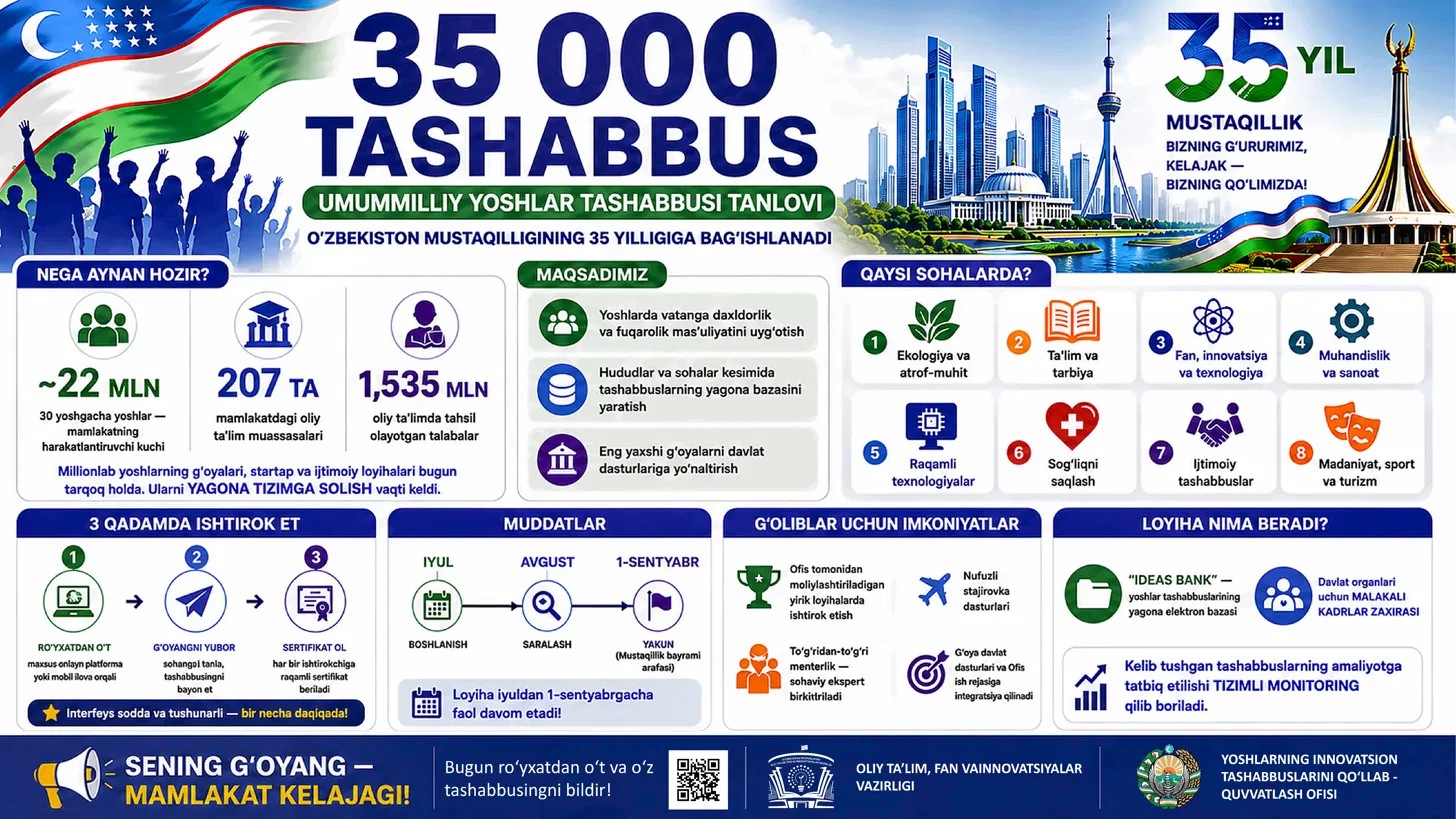
Take part in 3 steps
-
01
Sign up — Create a profile on the dedicated digital platform in minutes.
-
02
Submit your idea — Pick an area, describe the initiative and upload documents.
-
03
Get a certificate — Every initiative author receives a digital certificate.
Program timeline
-
17 July
Proposal
The Office submitted a proposal to the Minister to run the program.
-
July – August
Intake and screening
The platform launched; a working group screened applications in stages.
-
1 September
Active phase ends
The active intake phase closed on the eve of Independence Day.
-
From September
Permanent system
Intake and support of initiatives continue on a permanent basis.
The journey of 12,473 initiatives
The platform keeps an electronic card for every initiative: its status updates in real time, so every application can be tracked to the end.
- Approved5 576
- Returned for revision3 464
- Under review2 803
- Rejected630
Approval rate among reviewed applications — 45%.
Two-stage review
I · Technical screening
Completeness, required documents and the author’s eligibility are checked. Incomplete applications go back to the author.
II · Content review
The working group assesses the substance: the initiative is approved or rejected with a reasoned opinion.
Evaluation criteria
- Relevance
- Feasibility
- Social and economic impact
- Level of innovation
- Creativity
- Team capacity
A return is not a penalty: the author gets the reasons and recommendations and can revise and resubmit. Similar projects are grouped, with proposals to merge them and adapt them to regional needs.
Activity map: 14 regions, 3 institution types
295 institutions (27%) have submitted at least one initiative. The five most active regions account for two thirds of all initiatives.
83% of universities take part and submitted 98% of all initiatives (12,242).
Private and foreign institutions have higher coverage, yet 85% of initiatives came from state institutions.
By region
| Region | Institutions | Taking part | Coverage | Approved | Initiatives |
|---|---|---|---|---|---|
| Fergana region | 94 | 30 | 32% | 1 253 | 2 845 |
| Tashkent city | 175 | 92 | 53% | 1 192 | 2 458 |
| Samarkand region | 99 | 25 | 25% | 692 | 1 398 |
| Khorezm region | 64 | 9 | 14% | 422 | 1 177 |
| Surkhandarya region | 75 | 14 | 19% | 408 | 937 |
| Tashkent region | 86 | 22 | 26% | 246 | 544 |
| Republic of Karakalpakstan | 71 | 21 | 30% | 253 | 532 |
| Andijan region | 83 | 18 | 22% | 212 | 515 |
| Namangan region | 76 | 12 | 16% | 195 | 450 |
| Syrdarya region | 36 | 5 | 14% | 142 | 411 |
| Jizzakh region | 43 | 9 | 21% | 156 | 360 |
| Bukhara region | 67 | 12 | 18% | 157 | 330 |
| Kashkadarya region | 91 | 18 | 20% | 146 | 292 |
| Navoi region | 38 | 8 | 21% | 102 | 224 |
Regions sorted by number of initiatives. Source: Office report as of 14 September 2026.
Most active institutions and key findings
Activity is often driven by a region’s large universities — so work is done at the level of individual institutions.
Fergana State University leads with 2,098 initiatives.
Key findings
-
01
The program is firmly established in higher education: 83% of universities take part.
-
02
Vocational education is the main reserve: colleges are two thirds of institutions but under 1% of initiatives.
-
03
Coverage and activity are not directly linked — deepening activity within participating institutions matters.
-
04
Regional imbalance persists: the top 5 regions give two thirds of initiatives.
-
05
Over a quarter of initiatives were returned due to formatting gaps — methodological support will be stepped up.
Next steps
- Targeted work with the 803 institutions yet to apply, starting with colleges
- Dedicated work with the authors of 3,464 returned initiatives
- Complete review of the 2,803 pending applications on schedule
- Channel approved projects into acceleration, contests and grants
- Hands-on seminars for leaders in low-activity regions
- Weekly monitoring and regular reporting to the Ministry
Where approved ideas go next
Approval is not the finish line. Each project gets a support tool matched to its stage and field.
Support tools
- Acceleration and incubation programs
- Innovation idea and startup contests
- Grant and competitive funding
- Advice on pitching, business models and IP
- Research supervisors and technopark test sites
Opportunities for winners
- Priority participation in large local projects funded by the Office
- Prestigious internship programs
- Direct mentoring and expert support
- Integration of the idea into the Office’s plan and state programs
Your idea is the country’s future!
Intake and support of initiatives continue on a permanent basis. Approved projects are referred to acceleration programs such as “InnoLab”.